Showing posts with label Blue Ridge Mountains. Show all posts

Friday, August 12, 2011

MARY RICKETSON: SINGING THE POETRY OF PLACE


Few poems speak to our love of place and the way it can enrich and enlarge our spirits as well as Mary Ricketson's Lost in the Roar of Big Santeetlah.   When we fall in love with a place, as Mary  reveals in this poem, we want to carry that love with us, giving it away generously to the world at large.  This is how we will save our places from degradation, this is the legacy we will leave to our children.  


Mary's poem recently won the poetry contest sponsored by the Joyce Kilmer Memorial Forest, itself a legacy of what remains of the old growth forests that once flourished in our mountains.  Only a few stands remain now.  Big Santeetlah Creek runs through this beloved landscape.  Mary's poem is a fine and appropriate way to celebrate the 75th anniversary of the Kilmer Memorial Forest.  

Mary lives in Murphy and has been an active member of the Writers Network West for years.  She published a chapbook, I Hear the River Call My Name, with Finishing Line Press in 2008, which I featured on my North Carolina Laureate's Writers & Books site.  You will find out more about Mary there.


Lost in the Roar of Big Santeetlah


I cross a wooden bridge.
A stand of dark red trillium
waits for my attention.
White violets and crested dwarf iris
sit quietly at trail’s edge.  Birdsong begins.
Butterflies dance. Jack in the Pulpit presides.
River birch, pine and poplar stand tall.
Rippling water stills my thoughts.
I can taste the wind.

Soon pink lady slipper will bloom,
then purple rhododendron.
I know every season at this forest.

I fell in love here long ago,
found comfort on this path,
met parts of me I did not know,
told secrets never spoken.
Trees made promises
then asked for mine.
I fill myself with peace and hope when I am here
then give it all away when I am gone.


=

Sunday, August 7, 2011

August in the Mountains: Late Bloomers


Late bloomers struggling for a last glimpse of sun, my zinnias make do with not quite enough sunlight and not quite enough space at the edge of the garden.  Our lush spring greens --mustard, lettuce, collards, chard--are long gone, and I haven't yet seeded my  fall garden.  This time of year leaves me looking at bare garden soil and tomato plants that have once again disappointed us.  But the cucumbers are coming on strong.  Pickles!  Oh yes.....


Hearts a'Busting open their seedfire, their audacity giving me hope for busting out of my own late summer lethargy.


A lone butterfly clinging to ironweed makes an apt metaphor when I feel time, and summer, slipping away.  Hang on, golden wings!  Soon you will turn into golden leaf hanging onto the branches atop our ridge, then lingering awhile in flight before settling like golden and russet wings to the leafmeal below.


Time's arch, a swish of leaves presaging fall, makes me stop to catch one nano-second of late summer light with a shutter click.


Ironweed, I love you more than Joe Pye Weed, though both of you stand tall against the coming  autumnal transformations, determined to come back again when the timing's right, late bloomers
who never give up, sturdy homesteaders staking your claim to the places you've sunk your  roots into,
your stubborn roots.  May my roots hold fast, as stubborn as yours.   

Friday, August 5, 2011

Dark Turn of Mind

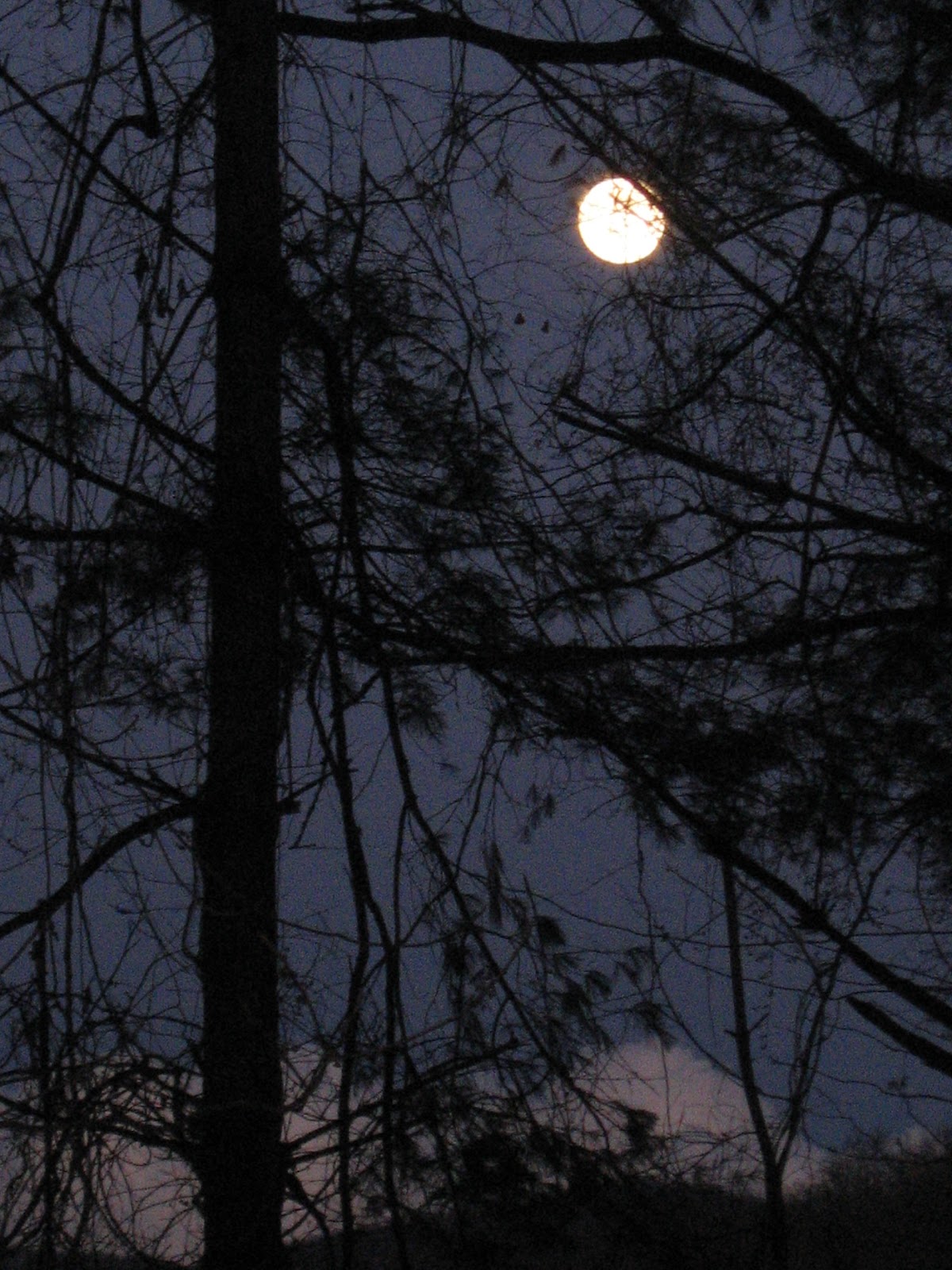
Turn around and there outside, through the window just over your kitchen sink, you see the sky turning dark, the trees stark against it like bony fingers.  Your mind turns and turns, from one dark place to another.  The candles gutter out.  No moon.  Swallowed up in the dark window, your dark turn of mind.


What do you do now? What pulls you back from the edge, gets you through the night, through that dark turn of mind that always leads to a dead end?

You finger the fraying edge of a quilt, the one passed down and down, the one with a name like Winding Way or Carolina Lily. Or maybe you walk out to the porch if it's summer and fondle the morning glory vines climbing up the trellis. They keep reaching  with their pretty blooms, these flowers, these quilts, these dried sprigs of lavender a friend gave you. That little touch of lace at the hem of your nightgown. That little ribbon of song you sing.

Your pretties.  You hold them fast against theft.  You hoard them against dark hairpin turns. Switchbacks
that scatter a woman's thoughts if taken too fast.

Your own thoughts.  You gather them up for safekeeping.

You keep them warm against your breast, like the bird lying dazed on the grass beneath your window. You cradled it a long time until you felt the wings stir. You opened your hands. There it sat, gathering itself, getting ready. And then it flew ...


Saturday, July 2, 2011

MOUNTAIN TIME


Way Back in Weyahutta


Every yard blooms a fine Rose

of Sharon, mere shadow

of Delphia’s embroidery floss

stitching her way around

all the rough edges.


So began a poem years ago celebrating the "pretties" blooming in the yards of mountain women who lived in the section called Weyahutta, or "Worryhut", just off the Tuckasegee River. The woman mentioned in it, Delphia Potts, has become in my imagination a guiding spirit, one of those "prophetesses" that Emma Bell Miles writes about in her classic book, The Spirit of the Mountains. Her daughters Annie Lee and Willa Mae became two of my dearest friends, and they too are among my guiding spirits. Annie Lee's daughter Norma Bryson sat in my first freshman composition class at Western Carolina University. I will be writing more about this lineage later. All three women were excellent seamstresses; their needles did indeed stitch their way around many rough edges. This website will honor them and their indomitable "spirit of the mountains." Here is an excerpt from my poem "Mountain Time," in which Delphia sets us straight about the work we are called to do, no matter how difficult the circumstances, how crazy the world around us becomes.


From "Mountain Time"


All roads seem to lead

to Millennium, dark roads with drop-offs

we can't plumb. It's time to be brought up short

now with the tale-tellers' Listen: There once lived

a woman named Delphia

who walked through these hills teaching children

to read. She was known as a quilter

whose hand never wearied, a mother

who raised up two daughters to pass on

her words like a strong chain of stitches.

Imagine her sitting among us,

her quick thimble moving along these lines

as if to hear every word striking true

as the stab of her needle through calico.

While prophets discourse about endings,

don't you think she'd tell us the world as we know it

keeps calling us back to beginnings?

This labor to make our words matter

is what any good quilter teaches.

A stitch in time, let's say.

A blind stitch

that clings to the edges

of what's left, the ripped

scraps and remnants, whatever

won't stop taking shape even though the whole

crazy quilt's falling to pieces.


from BLACK SHAWL, LSU Press, 1998