Showing posts with label Appalachian poetry. Show all posts

Tuesday, April 3, 2012

POETRY MONTH DAY # 3: DAVID HUDDLE


I've been a David Huddle admirer for years now, and no, that's not David in the photo above.  It's one he emailed me, in honor of the bird that has figured prominently in the  poems below.   I'm partial to his poetry, but he's also a highly regarded fiction writer, essayist,  and, I'd wager, a memorable teacher.  I was able to meet him five years ago at the anniversary Celebration of the Emory & Henry Appalachian Writers festival, at which time he was teaching in Vermont.  He's a mountain man, though, a Virginia mountain man, and for the past couple of years he's been teaching at Hollins College, his title being Distinguished Visiting Professor of Creative Writing.   
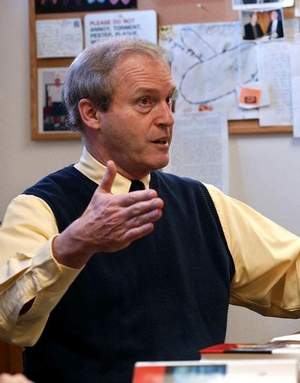


He has published seventeen books of fiction, poetry, and essays. His novel The Story of a Million Years (Houghton Mifflin, 1999) was named a Distinguished Book of the Year by Esquire and a best Book of the Year by the Los Angeles Times Book Review. In 2012, LSU Press will publish his seventh poetry collection, Black Snake at the Family Reunion, from which the following poems are lifted.  ( I'm justifiably proud that the two of us will have our  books coming out at the same time-early fall-- from the same publisher! )

Weather Report
 

The vultures of this landscape came to call 
this morning--found a bare-limbed tree outside
my kitchen window, settled in & held
my gaze, big tar blobs against a milky sky:
We understand you, their presence informed me,
And I you, I told them in silence.
      
                                            Right now 
this day can’t make up its mind--sun’s half out
but rain’s in those clouds.  If it’s that cold wind-
driven stuff that swats your eyes like a drink 
full of crushed ice thrown in your face, I’ll stay
indoors, count my failures & petty crimes,
loathe my life, and completely understand 
why friends and loved ones keep their distance.
The barometer yo-yos my mental state--
one day I’m a happy old dude, kitchen 
dancer, car-driving harmonizer, hilltop 
walker delighted by the world.
      
                                              Next day 
it’s the big not, the mega-never.  And where
are you breeze-blown death birds now that I need you?
This mean rain’s rotting the starch right out of me.
Come down from your perch, my beauties, I’m 
opening doors and windows, I’m looking for snacks
in the back of the fridge.  Here--try roosting 
on this chair back.  Please just sit with me 
around my table.  I’ll hold up both ends 
of our conversation.  It’s like forever
I’ve wanted to talk to you.  Here--let me 
turn off these lights--I know you like the dark.  

(first published in The New Yorker)

Hilltop Sonnet


Who visits this high meadow, lawn of the dead,
 to see blue and bluer mountains that rise
  out of the west; to converse with the crows,
   great-winged turkey buzzards, black kites riding
    thermals in seamless silence; to greet deer
     here at twilight grazing near the wood’s edge;
      to scare the huge groundhog that lives inside
       the brick-walled graveyard: Who moves through this     space?

       A yellow dog leading a deaf old man 
      who likes to talk, a girl and her boyfriend
     who sit atop her car’s roof murmuring
    quietly, two off-leash labs ignoring
   their shouting owner, a policeman who 
  parks up here to feel lonely, guarding the wind.


Roanoke Pastorale


Cardinal, goldfinch, titmouse, turkey buzzard--
dear companions of my afternoons--
above this field, high clouds dream of blizzards

to snow me in till spring ends my solitude.
Sober’s my binge now, nature my saloon. 
Wren, mourning dove, house finch, turkey buzzard--

for your entertainment, I sing the words
of old fifties songs, use baby talk, croon
as I walk the field beneath great blizzard-

dreaming clouds.  You gaudy pretties, sweet birds
of my senior years--my later’s my soon.
Catbirds flit through cedars in the graveyard, 

turkey buzzards swirl their patterns overhead,
across the mountainside sunlight bows a tune 
rising to blue eternity but heard

by the heron fishing the creek, wizard
of stillness, creature designed by the moon.
Bluebird, jay, chipping sparrow, turkey buzzard,
clouds, and field--I dream this life, walk this world.


(first published in The New Yorker)

Photo by Anne Noble

Monday, April 2, 2012

National Poetry Month: Anne Clinard Barnhill


National Poetry Month 2012, Day 2


Anne Barnhill dropped by City Lights Bookstore in Sylva, NC a few weeks back to talk about her new novel, At the Mercy of the Queen.  Her poetry chapbook titled Coal, Baby had not been released yet.  It was waiting in the wings.  Now it has flown out into the world, or soon will be, and I can feature some of the poems on its pages to celebrate National Poetry Month.   
If you go to Anne's website, you'll find out more about her, but for starters, here's her short biography.


"Anne Clinard Barnhill has been writing or dreaming of writing for most of her life. For the past twenty years, she has published arti cles, book and theater reviews, poetry, and short stories. Her first book, AT HOME IN THE LAND OF OZ, recalls what it was like grow ing up with an autistic sister. Her work has won various awards and grants. Barnhill holds an M.F.A. in Cre ative Writing from the Uni ver sity of North Carolina at Wilming ton. Besides writ ing, she also enjoys teaching, conducting writing work shops and seminars to enhance creativity." 


The Angel of Appalachia Speaks


Awaken the trees.
Call the clouds to collect themselves
and march the mountains to the sea.


Gather starbuds.
Shepherd every skittering thing—
beetle, grub, spider, snake—
all the crawling ones of the earth.
Lead them to the water.


The birds of the air
and the creatures of the deeps—
starfish and kingfisher
catbird and calico
deer and panther—
bring them.


Deliver the children of dust,
the bare, two-legged ones.
Call all to the banks of oblivion--
the air itself and the sad, sad rivers,
boulders and shattered rocks,
fragmented fossils and live veins of coal--
direct them to the blistering waters.


There, they will weep together
for all that is lost.


After  they have re-salted the earth with their tears, 
after they can no longer stand,
they will sink until their cheeks press against the pebbled bank
and their bones feel the pull of naked earth.


Snow Angel


The first snow made us light-hearted,
hopeful the inches would pile up.
When they did, you bundled me, yourself, too.
Up King’s Hill we tramped,
our sleds trailing us, slow as mules.


Atop, we warmed stiff mittens
over the garbage-can fire.
I lay my heart against the wooden slats—
the thudding, a quick comfort—
You pushed me off, down
    down
down

Cold wind in my nose, ice pricks on my cheeks—
Houses, legs, bushes, dogs—
My belly skirting snow piles—
Finally, the slow glide to safety,
you close behind.


Old Bob Gaul


I saw him often on our one-horse Main,
smelling of dirty socks, sour wine, urine.
Beneath his unzipped fly
it hung, one eye staring, a dead fish.
Sweet snow danced on his matted hair,
that hatless head a roost for pigeons.


Schoolboys taunted him while he gathered 
his harvest of coke bottles.
Grown-ups gave him a wide berth
and matched his averted stare.
In winter, he came to church,
his back pew in ready reserve.
He hunkered into it
like a scolded dog.


Rumor swore he’s been a pianist,
some young Mozart gone awry.
Hard to believe there’d been that kind of light
in his red, dead-panned eyes.


Once, at midnight, on a back-road haunt,
far from any place I’d been,
in the clearing, a one-room shack--
his shadow bent low to the concert grand,
the air rippled mountain arpeggios,
thrilled wild with thundering chords
crashed against granite peaks.


Friday, February 17, 2012

TSUGA, BY ADAM BIGELOW


Adam Bigelow is a horticulturalist, amateur botanist, organic gardener, musician, community activist, environmentalist and currently a member of The Great American Job Hunt.  Add to that description "poet." He recently sent me this poem, as part of my Guest Blogger project. 


   The hemlock, like so many of our trees, is threatened.  Adam calls the dead and dying ones ghosts, haunting us, as well they should.  This morning, awake early after my husband's rising at 6:00 a.m. to hike Cove Mountain, I look out the window at my own trees, the ones that greet me each dawn, and remember how trees, the Green Gods as I call them, have gathered around me all my life, beginning with the live oaks from my childhood.  I would wake up just as light was filtering down through their branches and watch them slowly take shape as another day began.


I've included a brief definition of Tsuga, to introduce Adam's poem.  We need our scientific definitions, of course, but we need our poems, too, connecting us to the world around us in ways that definitions cannot.  


Tsuga ( /ˈsuːɡə/,[1] from Japanese: 栂 (ツガ), the name of Tsuga sieboldii) is a genus of conifersin the family Pinaceae. The common name hemlock is derived from a perceived similarity in the smell of its crushed foliage to that of the unrelated plant poison hemlock.
Unlike poison hemlock (Conium), the species of Tsuga are not poisonous.


TSUGA
The ghost trees haunt the trailside
(soon they will be falling)
a stark contrast to the green of the mountains,
they stand.  Some still flush green tips
you know, the edible part?
But most have turned grey,
the color of gravestones,
as if marking their own demise.


The ghost trees haunt the creekside
standing like smokestacks burning through the night.
Climate change, to the trout,
and the crawdad,
the caddis fly, and the hellbender
who depend on coolness to thrive
(soon they will be falling, one by one)

The ghost trees haunt the lakeshore
(soon they will be falling)
creaking like masts in the wind,
this haunted pirateship droops with moss and death
As it awaits gravity, and duff.

Soon they will be falling.
There’ll be no stump sprouts 
To mark their place, 
No young leaves to point to and say,
“There, there one stood.
Before invasion took them away!”
like the mighty that have fallen before.

Soon the ghost trees will be fallen
and rotted away, with 
nothing left to remind us.

Once the trees have gone, 
and there remain none for 
the invader to feast upon,
the seed bed can burst forth with life,
and Tsuga will rise again
to the canopy.

Until then,
it remains
 for us to remember.

---Adam Bigelow


Thursday, August 11, 2011

MOON-ROUSED


Walking to my car outside City Lights Bookstore a few nights ago, I glimpsed through the hillside branches a half-moon, bright as a wafer.  Or a rice cracker.  Begging to be grabbed and nibbled.  Or gobbled.  The full moon can stir up appetites that lie dormant,  just waiting to be roused from slumber.

The natural world always throbs more audibly when there's a moon in the sky.  Maybe the moon is night's heartbeat?
    
The moon is magical, especially when it floats on the surface of ponds or water pails.  Imagine washing your hair in moonwater.  Years ago I imagined a mountain woman doing just that.  Hearing the hounds baying.  Her own heart beating.  Something wild stirring inside her.


Caught in my basin, the moon
shimmies.  She must feel low
down tonight, floating there
like some big-city show


girl’s silk underwear,
daring me stir up her lather
and scrub till I’m crazy
with moon shine, the better


to see my way clear
through the thick of my mama’s
keep, thirsty for what makes
my teeth ache.  This summer


I’ve nothing to dream on but dirt
roads, my mouth full
of singing that swells like the creek
jumping bank at the pull

of the honky-tonk season.
I’m game to go prowling
the backwoods with every bitch
loosed for a dozen miles, howling


at first sight of Her rising
over the pine scrub of Hell’s
Thicket, where in the last
eyes of wolf I hear tell

of, she still
burns, closing in for the kill.

from Black Shawl.