Monday, February 29, 2016
The Vegan Body Project: Governor Pat McCrory, thanks (but no thanks) for this useless lapel pin
The Vegan Body Project: Governor Pat McCrory, thanks (but no thanks) for this useless lapel pin: Create a Link

Monday, January 21, 2013
ON INAUGURATION DAY: LINDA HOGAN

On this Inauguration Day, I celebrate a poet whose poem, First Light, sings forth our first Americans' legacy, the love of this land, this ground upon which we live. Linda's lineage is Chickasaw, the tribe who once lived on the land where I grew up.
To those who came before me, and to the grandmothers who watch over us from the holes in the sky through which buffalo came, I give thanks. And to Linda Hogan. I still remember our drive through the Smoky Mountains to the Pancake House outside Gatlinburg.
If I had a prayer on this day, I would pray for White Buffalo Woman to come back to us, all of us, regardless of tribe, bearing the sacred pipe, to teach us the ways of peace and healing. Bison once roamed these mountains where I now live. And once I had a vision of White Buffalo Woman on the trail ahead of me. Perhaps she was the young woman I saw coming toward me that day in April, dressed "all the way white," as we say here in the Blue Ridge. That young woman appears my my poem, "Last Light."

First Light
In early morning
I forget I'm in this world
with crooked chiefs
who make federal deals.
In the first light
I remember who rewards me for living,
not bosses
but singing birds and blue sky.
I know I can bathe and stretch,
make jewelry and love
the witch and wise woman
living inside, needing to be silenced
and put at rest for work's long day.
In the first light
I offer cornmeal
and tobacco.
I say hello to those who came before me,
and to birds
under the eaves,
and budding plants.
I know the old ones are here
And every morning I remember the song
about how buffalo left through a hole in the sky
and how the grandmothers look out from those holes watching over us
from there and from there.
Last Light
The tests I need to pass are prescribed by the spirits
of place who understand travel but not amnesia.
from “This Is My Third and Last Address to You” --Adrienne Rich
1.
Almost the age when memory falters,
I fear being made to count backward
by seven’s, to answer to date, year, and
Presidents, as if those numbers and names
matter more in the end than this place
where I stand at the same kitchen window,
observing the same pines set swaying by wind,
reaching upward as I’ll reach, come morning,
my arms to the ceiling, breathing the dark out
of body and spirit, exhaling that old dream
of nothingness: laying my head down to sleep.
2.
Now Rocky Face Ridge catches fire
in the last light and, though I can’t hear it
from where I stand, Cullowhee Creek tumbles into
the Tuckaseegee, always unscrolling beneath me
the names I already know. Snowbird.
Buzzards Roost. Weyahutta. Oconaluftee.
. 3.
I don’t know how long names can last
if there’s no one to care where they live.
What I saw on the hairpin curve down from
the Chimney Tops, white as snow, I’ve not forgotten.
Phacelia. And how, on the trail leading
up to the summit of Suncota Ridge,
I saw sauntering toward me a young woman
I could have sworn was the reincarnation of
every spring wildflower ever named anywhere.
4.
Closer she comes to me each April,
as if she means more than I have a lifetime
to know. Roundabout her, her white Easter dress
whispers every thing I want to keep living
here in this valley that cups the last swallow of light,
every name I must reach to remember or else
lose them, hillside by hillside, to darkness.
Sunday, December 23, 2012
A Sheaf of Christmas Poems

Going through old computer files yesterday, I found these Christmas poems, originally part of the manuscript that became BLACK SHAWL. I saw Mary in these pieces as being here in the NC mountains rather than being a young girl in Nazareth over 2000 years ago. The reader at LSU Press suggested they be dropped, that they functioned better as a small chapbook of poems to be published later. They've waited ever since. As well as I can remember, they were first printed years ago in a journal whose poetry editor was my friend Janice Townley Moore. The Georgia Journal, I believe was its name. Anyway, here they are again, two days before another Christmas. The photos come from sunsets in S. Georgia and holly bushes, as well as waxing and full moons, here in the mountains.

BLUE
is her color
because it was always the last
thing she saw through
her window before losing
count of the heddle’s
beat. Blue hem
beyond reach, she
dreamed herself
wearing it, skirt flaring
out of the narrow glass
where she saw turning
and turning her own image
till in a swoon
she might gather up into the blue
lap of heaven
the stars and the moon
as if they were no more than
the first fruits of May,
the wild strawberries
she loved to eat as she carried
them home to her table.

AVE
This wind!
She cannot hold her bonnet
against it and lets go
the sashes. A kite of blue
calico sails away over
the fields while a child laughs
and points at the spectacle,
blustery March making light
of her modesty till not a hairpin’s
left clinging, her heavy braids
tumbling like bell-ropes
around her. So here she stands,
skirt swelling forth in its manifold
emptiness, as if she’s come
to the edge of a sea
and hears far out a voice
calling, gull maybe,
though she lives nowhere near
water and she knows her name
is not BEATA.

OH MARIA, MARIS STELLA
what have we made of you,
when you were happy enough to be nursing
your baby, ignoring the tumult of heaven,
the scuffle of shepherd’s feet.
Wise men on camels meant little to you,
their frankincense, myrrh.
You could take it or leave it.
What good would it do you
whose only concern was the milk you felt
slowly beginning to thicken your breasts?
Or the worry that Joseph had not eaten,
you should have brought along more
of your grandmother’s journey-cake,
more of her dried figs and almonds.
No seafarer's daughter, you grew up
to quail at the stories of drowning men
merchants brought back from the sea ports,
for you were no braver than most women.
You liked to think of yourself as a drop
in the Lord’s deep and, save for a scribe’s
error, you might have stayed "stilla maris"
forever. You had no desire to be star
to whom mariners cried out
for centuries, struggling to grab
hold your sleeve as they’re sinking.
YOU SIT
looking out at the straggle
of sheepherders leading their flock
to the hovel where you are still groggy
from childbirth. You wish they would go away,
seek out some other to worship,
for you are too tired to look blessed.
But it is expected of you.
Now and for two thousand years you must
lift up your eyes from your infant
and hear us out, bearing
such words as could almost make you
believe you are beautiful.

JOSEPH
And what of you, Joseph? Still lost in the barn
shadows, stroking your beard
while the curious goats crowd about her,
as if they have already guessed who she is,
not just any poor country girl born
to the tending of livestock. When she calls,
you do not go near.
Is the sight of such bringing forth
more than you fear you can bear?
Not to mention her blood
and the odor of animal everywhere.
All night you stand in the dark stall pretending
your name never crosses
her lips. How much longer before you will go
to her, man enough at last to look
upon God in His baffling dependency?
Monday, October 8, 2012
Friday, August 17, 2012
Saturday, June 9, 2012
The Quilts Left Behind....and Re-discovered
When I was home two weeks ago, I went poking around the attic in our old and now empty farmhouse. Underneath the attic stairs was a cubby hole, what I'd call a hobbit hole, in which we found several old quilts no doubt sewn by my grandmother Marion Fry Stripling (Bailey). They'd not seen the light of day in who knows how long, with portions of them frayed, eaten or rotted away. My grandmother was a N. Georgia mountain woman, so quilting would have been part of her heritage. I'm wondering what to do with these quilts. Portions of them are too beautiful to be thrown away. If anyone can help me find someone to restore these quilts, or parts of them, I'd be grateful. I'm offering the photographs I made of these too long ignored beauties.

A large hole in the center of this quilt's universe!

Stains and frays....

Time consumes even the most beautiful edges of our creations.

So much like a fireworks exhibition!

Though more lasting, if we take care of what women's hands have created.

A large hole in the center of this quilt's universe!

Stains and frays....

Time consumes even the most beautiful edges of our creations.

So much like a fireworks exhibition!

Though more lasting, if we take care of what women's hands have created.
Sunday, June 3, 2012
A CRADLE OF GREEN

The Appalachian range has been called "the vegetation cradle of North America."

Our mountains also cradle some of the most beautiful waterfalls and creeks on the planet.

Watching the water slide over these rocks, I thought of silk flowing around a dancer's lithe body.

And the sky, how the trees reach up to it, as if chanting Look up, Look up! And so I do. And then down again to the cradle of earth from which this glorious green grows.
Sunday, May 13, 2012
HERE, WHERE I AM: MOTHER'S DAY MORNING
HERE, WHERE I AM: MOTHER'S DAY MORNING
 Happy Mother's Day to all of those honor and sustain the mother who sustains us, this blue-green planet with her wildflowers and wonders. Her hungry mouths. Her many creatures huddled under leaf and brush and creek bed on this rainy Mother's Day morning.


Saturday, May 12, 2012
HERE, WHERE I AM: SOLACES
HERE, WHERE I AM: SOLACES
The Great Smoky Mountains Wildflower Pilgrimage renewed body and spirit at the end of April, the one T.S. Eliot called the cruelist month. Although the rain and hail Thursday morning sounded pretty cruel, the rest of the day was gorgeous, as was the day following. We all need to get out on the trails here in our mountains and smell the leafmold, search for the fragile and not so fragile plant life that abounds. Our mountains have been called the vegetation cradle of North America for good reason. We should let it rock us into solace when we need it. Or challenge us to action when we need to wake up.

The Great Smoky Mountains Wildflower Pilgrimage renewed body and spirit at the end of April, the one T.S. Eliot called the cruelist month. Although the rain and hail Thursday morning sounded pretty cruel, the rest of the day was gorgeous, as was the day following. We all need to get out on the trails here in our mountains and smell the leafmold, search for the fragile and not so fragile plant life that abounds. Our mountains have been called the vegetation cradle of North America for good reason. We should let it rock us into solace when we need it. Or challenge us to action when we need to wake up.

Wednesday, April 18, 2012
SLOW INTERNET CONNECTION

MY INTERNET CONNECTION HAS SLOWED TO A TORTOISE'S PACE, AND UNTIL IT IMPROVES, TRYING TO BLOG IS A HUGE FRUSTRATION. I HOPE TO BE BACK EVENTUALLY AND I HOPE YOU WILL JOIN ME.
Tuesday, April 17, 2012
ON TAX DAY, A SHORT ESSAY, BY CHARLIE G. HUGHES
My friend Charlie Hughes posted this on facebook back in November. Charlie runs the publishing house Wind, located in Kentucky. He's also a fine poet and prose writer, one of our region's best. This piece expresses his outrage at what is happening to so many vulnerable people in this country today. I will be featuring some of his poetry later.
*****************
Hughes grew up on a Kentucky farm. There he acquired an appreciation both for the natural world and t
 hings mechanical. Like many who came of age in the era of Sputnik, he became interested in science, both physical and natural. Always a voracious reader, often to the detriment of his assigned studies, he consumed endless volumes of science fiction, as well as sports biographies. He played on both his high school basketball and baseball teams, enthusiastically, if not very skillfully. Though, as a youth, he longed to escape what he perceived as the drudgery of the farm, he often revisits that locale in both his fiction and poetry.
Hughes holds degrees from Transylvania University and the University of Kentucky. Though employed as an analytical chemist, he has an abiding interest in the literary arts. He is the former editor of Wind, Kentucky's oldest active literary magazine. His poems and fiction have appeared in prominent literary magazines, includingKansas Quarterly, Kentucky Poetry Review, Hollins Critic, International Poetry Review, ART/LIFE, Cumberland Poetry Review, Exquisite Corpse, Appalachian Heritage, Cincinnati Poetry Reviewand others.
--------------------------------------
It’s November. When I come out of the auto-parts store, I decide to take a look at the stuff in the Goodwill Store next door. I like to inspect the shelves where I sometimes find used items that I can adapt or repair for my own use – I like to tinker.
When I’m ready to check out with a couple of items, I notice a young black woman, small, about 30 years of age, with several items of clothes stacked by the register. The check-out lady says she’ll total these up in her head before entering the items in the register. It comes to about $26. The young woman, a few dollars in her fist, begins to fumble in her purse, pulls out a small snap-top change bag from which she digs several coins. After searching and fumbling with bills and coins, she says something to the clerk who begins to set aside a couple of items, consult with the customer, and set aside another.
An older man in sweat shirt and blue jeans, next in line, a few dollar bills in his hand, shuffles a half-step nearer and says to the customer, How much do you need? Two dollars, she says. He drops the bills on the counter. She looks up at him and offers her thanks, then hangs her head slightly as she completes the transaction. Again, she offers her thanks before hurrying from the store.
After I leave the store I sit in my car for several moments, listening to the rain on the roof, thinking about what I’ve just witnessed. And I wonder if Senator Mitch McConnell, with winter coming on, ever needed two dollars to buy clothes. That evening on the TV news I learn that Obama’s jobs bill which would have provided jobs for hundreds of thousands and has been rejected by the senate. I think about McConnell again. I think about a hammer. I think about kneecaps.
Tuesday, April 3, 2012
POETRY MONTH DAY # 3: DAVID HUDDLE

I've been a David Huddle admirer for years now, and no, that's not David in the photo above. It's one he emailed me, in honor of the bird that has figured prominently in the poems below. I'm partial to his poetry, but he's also a highly regarded fiction writer, essayist, and, I'd wager, a memorable teacher. I was able to meet him five years ago at the anniversary Celebration of the Emory & Henry Appalachian Writers festival, at which time he was teaching in Vermont. He's a mountain man, though, a Virginia mountain man, and for the past couple of years he's been teaching at Hollins College, his title being Distinguished Visiting Professor of Creative Writing.
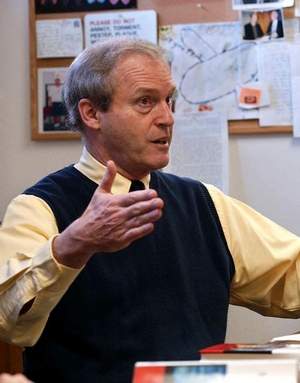
He has published seventeen books of fiction, poetry, and essays. His novel The Story of a Million Years (Houghton Mifflin, 1999) was named a Distinguished Book of the Year by Esquire and a best Book of the Year by the Los Angeles Times Book Review. In 2012, LSU Press will publish his seventh poetry collection, Black Snake at the Family Reunion, from which the following poems are lifted. ( I'm justifiably proud that the two of us will have our books coming out at the same time-early fall-- from the same publisher! )
Weather Report
The vultures of this landscape came to call
this morning--found a bare-limbed tree outside
my kitchen window, settled in & held
my gaze, big tar blobs against a milky sky:
We understand you, their presence informed me,
And I you, I told them in silence.
Right now
this day can’t make up its mind--sun’s half out
but rain’s in those clouds. If it’s that cold wind-
driven stuff that swats your eyes like a drink
full of crushed ice thrown in your face, I’ll stay
indoors, count my failures & petty crimes,
loathe my life, and completely understand
why friends and loved ones keep their distance.
The barometer yo-yos my mental state--
one day I’m a happy old dude, kitchen
dancer, car-driving harmonizer, hilltop
walker delighted by the world.
Next day
it’s the big not, the mega-never. And where
are you breeze-blown death birds now that I need you?
This mean rain’s rotting the starch right out of me.
Come down from your perch, my beauties, I’m
opening doors and windows, I’m looking for snacks
in the back of the fridge. Here--try roosting
on this chair back. Please just sit with me
around my table. I’ll hold up both ends
of our conversation. It’s like forever
I’ve wanted to talk to you. Here--let me
turn off these lights--I know you like the dark.
(first published in The New Yorker)
Hilltop Sonnet
Who visits this high meadow, lawn of the dead,
to see blue and bluer mountains that rise
out of the west; to converse with the crows,
great-winged turkey buzzards, black kites riding
thermals in seamless silence; to greet deer
here at twilight grazing near the wood’s edge;
to scare the huge groundhog that lives inside
the brick-walled graveyard: Who moves through this space?
A yellow dog leading a deaf old man
who likes to talk, a girl and her boyfriend
who sit atop her car’s roof murmuring
quietly, two off-leash labs ignoring
their shouting owner, a policeman who
parks up here to feel lonely, guarding the wind.
Roanoke Pastorale
Cardinal, goldfinch, titmouse, turkey buzzard--
dear companions of my afternoons--
above this field, high clouds dream of blizzards
to snow me in till spring ends my solitude.
Sober’s my binge now, nature my saloon.
Wren, mourning dove, house finch, turkey buzzard--
for your entertainment, I sing the words
of old fifties songs, use baby talk, croon
as I walk the field beneath great blizzard-
dreaming clouds. You gaudy pretties, sweet birds
of my senior years--my later’s my soon.
Catbirds flit through cedars in the graveyard,
turkey buzzards swirl their patterns overhead,
across the mountainside sunlight bows a tune
rising to blue eternity but heard
by the heron fishing the creek, wizard
of stillness, creature designed by the moon.
Bluebird, jay, chipping sparrow, turkey buzzard,
clouds, and field--I dream this life, walk this world.
(first published in The New Yorker)
(first published in The New Yorker)
 |
| Photo by Anne Noble |
Monday, April 2, 2012
National Poetry Month: Anne Clinard Barnhill
National Poetry Month 2012, Day 2

Anne Barnhill dropped by City Lights Bookstore in Sylva, NC a few weeks back to talk about her new novel, At the Mercy of the Queen. Her poetry chapbook titled Coal, Baby had not been released yet. It was waiting in the wings. Now it has flown out into the world, or soon will be, and I can feature some of the poems on its pages to celebrate National Poetry Month.
If you go to Anne's website, you'll find out more about her, but for starters, here's her short biography.
"Anne Clinard Barnhill has been writing or dreaming of writing for most of her life. For the past twenty years, she has published arti cles, book and theater reviews, poetry, and short stories. Her first book, AT HOME IN THE LAND OF OZ, recalls what it was like grow ing up with an autistic sister. Her work has won various awards and grants. Barnhill holds an M.F.A. in Cre ative Writing from the Uni ver sity of North Carolina at Wilming ton. Besides writ ing, she also enjoys teaching, conducting writing work shops and seminars to enhance creativity."
The Angel of Appalachia Speaks
Awaken the trees.
Call the clouds to collect themselves
and march the mountains to the sea.
Gather starbuds.
Shepherd every skittering thing—
beetle, grub, spider, snake—
all the crawling ones of the earth.
Lead them to the water.
The birds of the air
and the creatures of the deeps—
starfish and kingfisher
catbird and calico
deer and panther—
bring them.
Deliver the children of dust,
the bare, two-legged ones.
Call all to the banks of oblivion--
the air itself and the sad, sad rivers,
boulders and shattered rocks,
fragmented fossils and live veins of coal--
direct them to the blistering waters.
There, they will weep together
for all that is lost.
After they have re-salted the earth with their tears,
after they can no longer stand,
they will sink until their cheeks press against the pebbled bank
and their bones feel the pull of naked earth.
 |
| Order from Finishing Line Press. |
Snow Angel
The first snow made us light-hearted,
hopeful the inches would pile up.
When they did, you bundled me, yourself, too.
Up King’s Hill we tramped,
our sleds trailing us, slow as mules.
Atop, we warmed stiff mittens
over the garbage-can fire.
I lay my heart against the wooden slats—
the thudding, a quick comfort—
You pushed me off, down
down
down
Cold wind in my nose, ice pricks on my cheeks—
Houses, legs, bushes, dogs—
My belly skirting snow piles—
Finally, the slow glide to safety,
you close behind.
Old Bob Gaul
I saw him often on our one-horse Main,
smelling of dirty socks, sour wine, urine.
Beneath his unzipped fly
it hung, one eye staring, a dead fish.
Sweet snow danced on his matted hair,
that hatless head a roost for pigeons.
Schoolboys taunted him while he gathered
his harvest of coke bottles.
Grown-ups gave him a wide berth
and matched his averted stare.
In winter, he came to church,
his back pew in ready reserve.
He hunkered into it
like a scolded dog.
Rumor swore he’s been a pianist,
some young Mozart gone awry.
Hard to believe there’d been that kind of light
in his red, dead-panned eyes.
Once, at midnight, on a back-road haunt,
far from any place I’d been,
in the clearing, a one-room shack--
his shadow bent low to the concert grand,
the air rippled mountain arpeggios,
thrilled wild with thundering chords
crashed against granite peaks.
Subscribe to:
Posts (Atom)